
Did you know that every four minutes, another driver in the UK puts the wrong fuel in their tank? It's a sinking feeling that immediately triggers a flurry of questions. Will I make it to work on time? Is my engine ruined? Most importantly, how long does a fuel drain take before I can get moving again? We understand the anxiety that sets in when you realise you've reached for the petrol nozzle instead of the diesel one. It's a common mistake, but it doesn't have to ruin your entire day. Stay where you are, keep the engine off, and let a specialist take over.
We're here to provide the professional reassurance you need whilst we handle the technical details. This guide explains exactly what to expect from the moment you call for help until you're safely driving away. We'll look at standard recovery times, the difference between a simple drain and a full system flush, and the specific factors that can speed up or delay your return to the road. You'll gain a clear arrival and repair estimate, along with the peace of mind that your car will be driveable today. Speed is a byproduct of expert equipment and safety protocols, and we're here to get you back on track safely.
Key Takeaways
- A standard roadside fuel drain typically takes between 30 and 50 minutes once your specialist arrives on-site.
- Understand exactly how long does a fuel drain take by looking at variables such as total fuel volume and specific vehicle accessibility.
- Learn why turning the ignition after a fuel mistake requires a full system flush, adding roughly 20 to 30 minutes to the recovery time.
- Follow the professional step-by-step process used to safely drain your tank and protect your engine's delicate fuel injectors.
- See how local 24/7 mobile coverage across the North East and North Yorkshire ensures the fastest possible arrival times.
The Short Answer: How Long Does a Professional Fuel Drain Take?
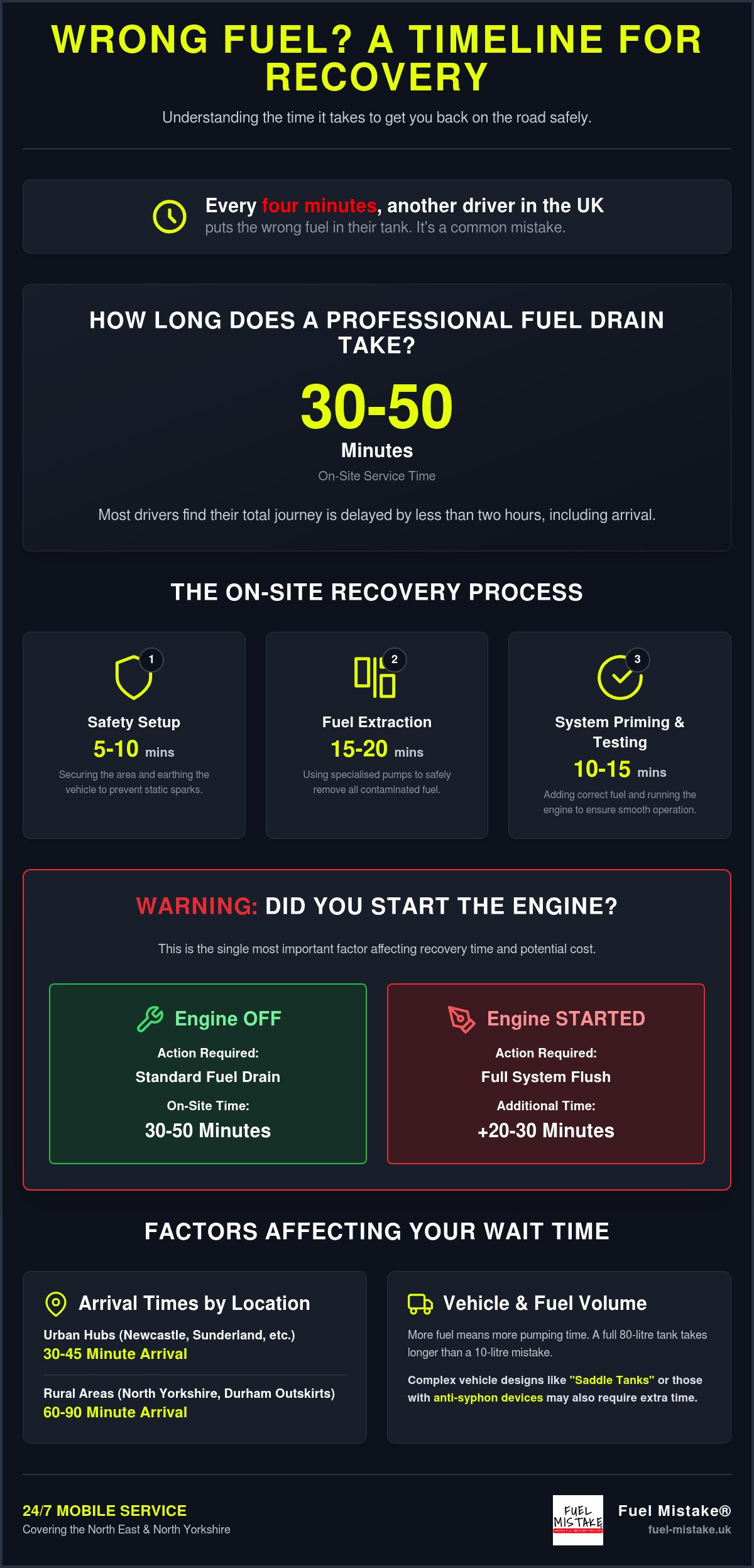
The most pressing question for any stranded motorist is usually about the clock. You have meetings to attend, school runs to complete, or family waiting at home. If you've just realised you've put the wrong fuel in your tank, don't panic. A standard roadside fuel drain typically takes between 30 and 50 minutes once the technician arrives on-site. When you factor in arrival times, most drivers find their total journey is delayed by less than two hours. This efficiency is why mobile specialists are the preferred choice over traditional recovery services that might leave you waiting for a tow truck for half the day.
Arrival Times: How Fast Can Help Reach You?
Your location dictates how quickly a specialist can be at your side. In busy urban hubs like Newcastle, Sunderland, or Middlesbrough, a technician can often reach you within 30 to 45 minutes. If you are further afield in rural North Yorkshire or the outskirts of Durham, arrival times usually range from 60 to 90 minutes. Traffic patterns on major arteries like the A1 and A19 play a significant role, but because we operate a 24/7 mobile service, help is always moving toward you. Unlike general breakdown clubs that often prioritise total breakdowns over mis-fuelling, a dedicated fuel specialist focuses solely on getting your tank cleared. This specialised approach bypasses the need for expensive towing and the long wait times associated with third-party garages.
The "On-Site" Phase: Breaking Down the 40 Minutes
Once the technician pulls up, the technical process begins immediately. It is a methodical, safety-first procedure that ensures your vehicle remains protected. Here is how those 40 minutes are typically spent:
- Safety Setup (5-10 minutes): The technician secures the area, positions the mobile unit, and earths your vehicle to prevent static sparks. Safety is the priority during any fuel extraction.
- Fuel Extraction (15-20 minutes): Using high-powered, specialised pumping equipment, the contaminated fuel is removed. This stage is vital because the fuel pump and injectors are highly sensitive to the wrong lubrication levels. Specialists use professional tools to bypass anti-syphon flaps and ensure the tank is completely stripped of the incorrect mixture.
- System Priming and Testing (10-15 minutes): After the drain, the system is primed with the correct fuel. The engine is restarted and monitored to ensure it runs smoothly, followed by final safety checks before you are cleared to drive away.
By following this rigorous protocol, a qualified technician ensures that how long does a fuel drain take is balanced against the technical necessity of protecting your engine. Most motorists are back on the road and driving safely in about the time it takes to have a quick lunch.
Factors That Influence the Duration of Your Fuel Recovery
Whilst many roadside situations follow a predictable pattern, the answer to how long does a fuel drain take often depends on several technical variables. It isn't just about the speed of the pump. Physical volume matters. Extracting a full 80-litre tank of contaminated petrol requires significantly more time than removing a 10-litre error. The pumping equipment can only move fluid at a set rate, so a larger volume naturally extends the on-site phase. If you've filled the tank to the brim, expect the extraction process to lean toward the longer end of the estimate.
Accessibility also plays a major role. Modern automotive engineering prioritises security and fuel safety, which often means tanks are fitted with anti-syphon valves and complex filler necks. These features are designed to prevent fuel theft, but they also make it harder for technicians to reach the fuel. Instead of a simple hose, specialists must use specialised probes to bypass these security measures safely. If you are worried about your specific car, contacting a mobile specialist for advice is the fastest way to get an accurate estimate for your situation.
Vehicle Make and Model Complexity
Prestige cars and modern SUVs often feature sophisticated fuel architectures that require extra care. Some high-end German models or large 4x4 vehicles utilise "saddle" tanks. These are essentially dual fuel reservoirs connected by a bridge, designed to balance weight across the vehicle's chassis. Draining these requires accessing both sides of the tank to ensure no contaminated fuel remains trapped. Technicians carry a vast array of adaptors for different filler necks to ensure they can connect their equipment without damaging the vehicle's internal seals or security flaps. This technical expertise ensures the job is done right, even if it adds a few extra minutes to the clock.
AdBlue Contamination: A Special Case
If you have accidentally added AdBlue to your diesel tank, the recovery process is more meticulous. AdBlue is not a fuel; it's a water-based solution containing urea. When it mixes with diesel, it can quickly lead to crystallisation, which can destroy your fuel injectors and high-pressure pumps. Removing it requires a more thorough cleaning process than a standard petrol drain. Technicians must flush the entire fuel line system to ensure every trace of the chemical is gone. For more details on this specific emergency, refer to our AdBlue in diesel tank guide. This extra care ensures your engine remains protected, though it typically adds 20 to 30 minutes to the total service time.
The Step-by-Step Breakdown: What Happens During the Drain?
Understanding the technical sequence of a recovery helps clarify how long does a fuel drain take and why specific steps cannot be rushed. It is a methodical process designed to protect your engine's high-pressure components from abrasive contaminants. A professional technician doesn't just "siphon" the tank; they perform a full system restoration using specialised mobile equipment. Each stage is handled with precision to ensure your vehicle's warranty and mechanical integrity remain intact.
- Step 1: Safety Setup. The technician first secures the work area with cones and earthing equipment. This prevents static discharge, which is a critical risk when handling volatile fuel mixtures.
- Step 2: Accessing the Tank. Modern vehicles are fitted with anti-syphon flaps. Professionals use specialised probes to navigate these barriers safely without causing internal damage.
- Step 3: Extraction. Using high-power vacuum pumps, the contaminated fuel is stripped from the tank. This is far more effective than gravity-based methods, as it removes the heavy sediment that settles at the bottom.
- Step 4: The Flush. This is where quality service differs from a basic drain. We add a small amount of fresh, correct fuel to rinse the tank and fuel lines, ensuring every trace of the incorrect mixture is neutralised.
- Step 5: Diagnostic Check. Once the system is primed, we start the engine and monitor the dashboard for any fault codes or irregular idling to ensure a perfect recovery.
Bypassing Anti-Syphon Valves Safely
You should never attempt to force a hose or a makeshift pipe down a modern filler neck. Modern cars use delicate anti-syphon valves and security flaps that are easily snapped or dislodged. If these components break, they can fall into the tank, leading to expensive mechanical repairs later. Professional technicians use flexible, industrial-grade probes designed specifically to navigate these complex fuel necks. This specialised equipment not only prevents damage but also significantly reduces the time spent on-site, ensuring the extraction starts within minutes of arrival.
Priming the System and the First Restart
Diesel engines are particularly sensitive to air entering the fuel lines. After a drain, the system must be primed to bleed out any air pockets that could cause the engine to stall or refuse to start. This priming process is essential for protecting the fuel injectors and the high-pressure pump from running dry. When the engine is first turned over, it might take a few seconds longer than usual to catch. This is normal behaviour whilst the fresh fuel reaches the combustion chamber. We stay with you until the engine is running smoothly and all dashboard warning lights are clear, providing total peace of mind before you pull away.
Why Starting the Engine Changes the Timeline (and the Cost)
Have you already turned the key? This single action is the most significant factor in determining your recovery time and the complexity of the job. Once the ignition is engaged, the lift pump immediately draws the contaminated mixture out of the tank and into the delicate components of your engine. This shifts the procedure from a standard extraction to a full system decontamination. If you are wondering how long does a fuel drain take after the engine has been running, you should expect to add at least 20 to 30 minutes to the standard on-site estimate.
The risk of permanent damage increases significantly once the incorrect fuel reaches the common rail. Petrol lacks the lubricating properties that diesel engines require, leading to metal-on-metal friction that can create microscopic debris. This debris can quickly clog injectors or damage the high-pressure pump. To understand the full extent of the risks involved with running your engine on the wrong mixture, consult our misfuelling guide for a detailed breakdown of potential engine damage.
Flushing the Fuel Lines and Injectors
If the car has been driven, even for a short distance, the fuel lines are no longer clear. A technician must perform a technical flush of the entire high-pressure system to ensure no contaminated fuel remains near the injectors. This step is non-negotiable for any vehicle that has been started. We use specialised equipment to purge the lines and replace the contaminated fluid with fresh, high-quality fuel. Fuel Mistake® technicians carry out this process methodically, ensuring the system is entirely pure before we attempt to hand the keys back to you. This rigorous approach is the only way to guarantee the vehicle is safe to drive.
The Cost of Delay: Prevention vs Repair
Calling a specialist immediately is the fastest and most cost-effective way to get back on the road. A mobile fuel drain is a fraction of the cost of replacing high-pressure pumps or a full set of injectors, which can run into thousands of pounds at a main dealership. Speed is your ally here. A mis-fuelled car that has not been started is in a "safe state" where the contamination is confined entirely to the fuel tank. By acting quickly, you prevent the contamination from spreading and keep your repair timeline as short as possible. If you need assistance immediately, request an emergency fuel drain from our mobile team to secure your engine's safety.
Emergency Fuel Drain Services in the North East: Rapid Response Times
When you are stuck at a petrol station in Newcastle or on the hard shoulder of the A19 near Middlesbrough, the only thing that matters is a fast resolution. Fuel Mistake® provides 24/7 coverage across the entire North East and North Yorkshire, ensuring that help is never far away. Because we are a local, family-run business with three generations of motor industry experience, we understand the regional road networks better than national call centres. We know how the A1 and A19 traffic patterns behave during rush hour, allowing us to navigate toward you using the most efficient routes possible. This local expertise is a key factor in answering how long does a fuel drain take; our goal is always to have you back on the road within two hours of your initial call.
Our service area extends deep into North Yorkshire, covering towns such as Thirsk, Northallerton, and Richmond. Whether you are at a motorway service station or parked in a residential driveway, our mobile units arrive fully equipped with prestige-standard extraction technology. We carry everything needed to complete the job on-site, usually in under an hour once we reach your side. This mobile-first approach eliminates the need for expensive towing and the frustration of waiting for a garage to open their doors the following morning.
Serving Middlesbrough, Newcastle, and Beyond
Our roots are firmly planted in the North East motor trade. Founded by a prestige dealership trained technician, Fuel Mistake® brings technical competence to the roadside that rivals any main dealer workshop. Being a family-run business means we treat your emergency with the urgency it deserves. You aren't just another ticket in a national system; you're a neighbour in need of specialist help. For specific details on our response times in the Tees Valley, see our guide on Emergency Fuel Drain Middlesbrough.
Contacting a Specialist for an Immediate Estimate
When you dial our emergency line, you will speak directly with a technician who can provide an immediate estimate. To help us give you the most accurate arrival time and price, please have your exact location, vehicle make and model, and an estimate of how much of the wrong fuel was added ready. We provide a clear ETA and a transparent price over the phone so there are no surprises when we arrive. Once you're ready to get moving again, call Fuel Mistake® now for an emergency fuel drain estimate and let our family-run team handle the rest.
Get Back on the Road Today
You shouldn't let a simple mistake at the pumps stall your entire week. As we have explored, a professional roadside recovery is a swift and methodical process that typically sees you driving away in under an hour once help arrives. By keeping your ignition off and calling for specialist assistance immediately, you minimise both the repair time and the risk of expensive engine damage. Understanding exactly how long does a fuel drain take allows you to manage the situation with confidence rather than panic. Whether you are in Newcastle, Middlesbrough, or a rural corner of North Yorkshire, our family-run team is ready to help.
We combine three generations of automotive expertise with specialist equipment for all makes and models to ensure a safe, prestige-standard result. Don't wait for a tow truck that might take hours to reach you. We provide 24/7 rapid response across the North East to get you moving again safely. Get an immediate fuel drain quote from Fuel Mistake® and let our technicians handle the technical details. You'll be back behind the wheel and on your way before you know it.
Frequently Asked Questions
How long do I have to wait for a fuel drain technician to arrive?
Arrival times generally range from 30 to 90 minutes across the North East and North Yorkshire. Your specific wait depends on your proximity to our local technicians in Newcastle, Sunderland, or Middlesbrough. We operate a 24/7 mobile service, so help is always moving toward you. Whilst traffic on major routes like the A19 can affect the clock, we provide a clear arrival estimate during your initial call.
Can I drive my car to a garage if I put the wrong fuel in?
You must not drive the vehicle if you suspect mis-fuelling. Even a short trip can pull contaminated fuel into the high-pressure system, leading to catastrophic engine failure. Driving turns a simple tank drain into a complex system decontamination that takes much longer to resolve. Stop the car immediately, turn off the engine, and stay in a safe place whilst you wait for professional assistance to arrive.
What happens if I started the engine before realising the mistake?
If the engine was started, the process changes from a simple drain to a technical system flush. Contaminated fuel is pulled through the pump and injectors, which requires us to purge the entire fuel line. This adds approximately 20 to 30 minutes to the total time on-site. It is a necessary step to ensure no abrasive particles remain that could damage the common rail or the fuel injectors.
Will a fuel drain affect my vehicle manufacturer’s warranty?
A professional fuel drain performed by a qualified specialist is the best way to protect your vehicle's mechanical health and warranty. Manufacturers prefer that mis-fuelling is handled by experts who follow industry-standard safety protocols. Leaving contaminated fuel in the system or attempting a DIY fix is far more likely to lead to long-term issues that could compromise your warranty coverage. We ensure the job is done to prestige standards.
Is a mobile fuel drain faster than using a main dealership?
Choosing a mobile specialist is much faster than a dealership. A main dealer requires you to tow the car to their workshop, where it might sit in a queue for days. A mobile fuel drain takes place at the roadside, with the actual work usually finished in under an hour. It's the most efficient way to get back to your schedule without the need for expensive towing or a hire car.
How much does a professional fuel drain cost in the North East?
Costs for a professional recovery depend on the volume of fuel and the complexity of the vehicle's tank architecture. When asking how long does a fuel drain take or how much it costs, remember that starting the engine adds to both the time and the technical requirements. We offer a transparent, fixed-price estimate over the phone, ensuring you know exactly what to expect before our specialist arrives at the roadside.
Do I need to replace my fuel filter after a fuel drain?
Replacing the fuel filter is often recommended if the engine has been run with the wrong fuel. The filter is designed to catch contaminants, and petrol in a diesel system can cause the filter element to degrade. Whilst not always mandatory for a simple drain where the ignition stayed off, it is a sensible precaution to ensure your fuel system remains pure and your engine stays protected.
Can you drain fuel from a car that has run out of fuel or has contaminated fuel?
Yes, we specialise in all forms of fuel contamination and roadside assistance. This includes AdBlue in diesel, water contamination, or simply running out of fuel on a busy road. Our mobile units carry the technical equipment required to strip the tank and lines of any unwanted fluids. We also provide enough fresh fuel to safely reach the nearest station, ensuring your engine is primed and ready to restart.


