
You’ve just pulled away from the forecourt and joined the flow of traffic on the A1 or A19, but suddenly, your engine starts to stutter and lose power. That sinking feeling in your stomach is usually right; you’ve likely grabbed the green nozzle by mistake. It’s an incredibly stressful situation that affects over 80,000 UK motorists every year, and we know the fear of a multi-thousand pound repair bill is likely racing through your mind as you coast to the hard shoulder.
Recognising the specific petrol in diesel car symptoms early is the only way to prevent a simple error from turning into a total engine disaster. You might be seeing conflicting advice online, but when your vehicle’s high-pressure fuel system is at risk, you need clear and professional facts. We’ll help you identify the critical warning signs and provide the exact steps needed to protect your car’s vital components from chemical damage.
This guide explains why your car is misbehaving, the severe risks of continuing your journey, and how our specialist mobile team provides a rapid solution across the North East to get you moving again without the need for a costly tow or a major mechanical rebuild.
Key Takeaways
- Learn to identify the telltale petrol in diesel car symptoms, such as engine stuttering and sudden power loss, before permanent damage occurs.
- Understand why petrol acts as a solvent that strips essential lubrication from your fuel pump, leading to catastrophic metal-on-metal friction.
- Discover the immediate steps you must take, including why you must remove the key, to stop the fuel pump from circulating the contaminated mix.
- See why modern Euro 6 engines are significantly more sensitive to misfuelling than older models and why even a small amount of petrol is a major risk.
- Find out how a professional mobile fuel drain at the roadside or forecourt can save you significant costs compared to major mechanical garage repairs.
Common Symptoms of Petrol in a Diesel Engine
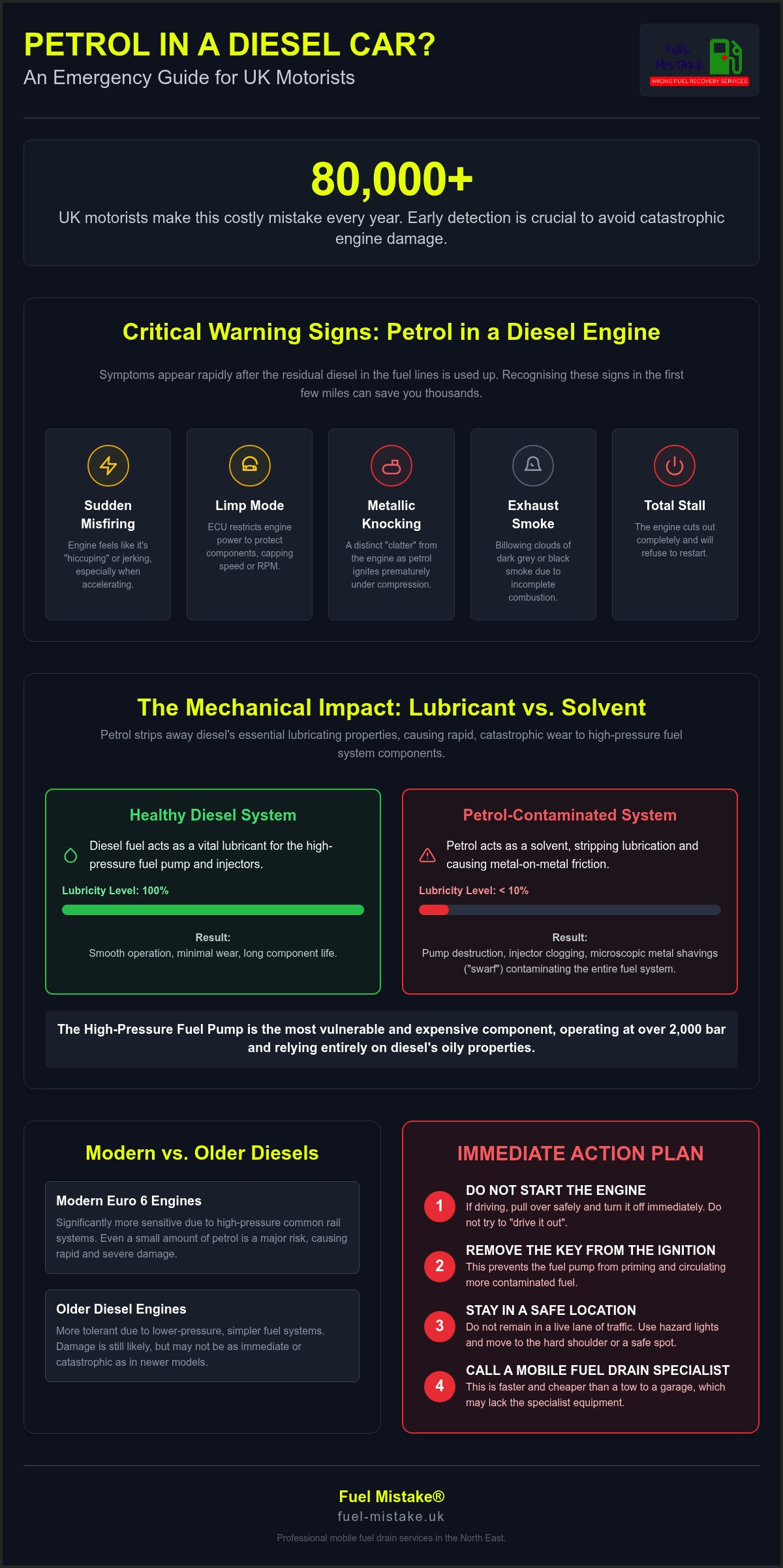
Most drivers expect an immediate engine failure the moment they pull away from the petrol station. In reality, there is often a "Silent Stage" where the car runs perfectly on the residual diesel left in the fuel lines and filter. This is the most dangerous period because you are unknowingly circulating a harsh solvent through your high-pressure pump. Once the petrol reaches the injectors, the physical petrol in diesel car symptoms will manifest rapidly and aggressively. Recognising these signs in the first few miles can be the difference between a simple fuel drain and a total engine replacement.
Look out for these specific red flags as the contamination levels rise:
- Sudden Misfiring: The engine will feel like it is "hiccuping" or jerking, especially whilst you are trying to accelerate or maintain a steady speed.
- Limp Mode Activation: Your car’s computer (ECU) may detect irregular combustion and restrict engine power to protect itself, often capping your speed or RPM.
- Metallic Knocking: You might hear a distinct "clatter" or tapping sound from the upper engine, caused by the petrol igniting far earlier than diesel usually would.
- Exhaust Smoke: Billowing clouds of dark grey or black smoke will often appear as the engine struggles to process the incorrect fuel mix.
- Total Stall: Eventually, the engine will cut out entirely, often at a junction or whilst idling, and will likely refuse to restart.
The "Lumpy" Idle and Misfiring
Diesel engines rely on compression ignition, but petrol has a much lower flash point and ignites prematurely under pressure. This mistiming creates a violent, irregular rhythm that vibrates through the steering wheel. Unlike a standard mechanical fault that develops over weeks, these petrol in diesel car symptoms appear within minutes of refuelling. A lumpy idle is the first auditory warning of fuel contamination. If your car sounds like a "bag of nails" at a red light, stop the engine immediately.
Smoke and Exhaust Emissions
Petrol burns incompletely in a compression environment, leading to a surge in unburnt carbon. Understanding Diesel fuel properties is essential here; diesel provides the lubrication and density required for a clean burn, whereas petrol acts as a thinning agent. This soot quickly clogs the Diesel Particulate Filter (DPF), resulting in thick, dark exhaust emissions. Ignoring this smoke can lead to secondary sensor failures or permanent DPF damage, which significantly increases your repair costs.
In most cases, the symptoms follow a predictable order: it starts with a slight loss of power, moves to a rough idle, and finishes with heavy smoke and a total stall. If you notice any of these signs after visiting a forecourt, do not attempt to "drive the petrol out" by topping up with diesel. This only forces the contaminated mix deeper into the delicate internal components of your fuel system.
The Mechanical Impact: Why Petrol Acts Like a Solvent
Diesel fuel is more than just a source of energy; it's a vital lubricant for the moving parts within your engine. In contrast, petrol is a chemical solvent designed to break down oils. The physical petrol in diesel car symptoms you experience are the direct result of a chemical battle occurring inside your fuel lines. When you accidentally mix the two, the results are physically destructive. Petrol reduces the lubricity of diesel by up to 90% almost instantly, stripping away the protective film that keeps your fuel system running smoothly.
The Destruction of the High-Pressure Pump
The high-pressure fuel pump is the heart of a modern diesel engine. It operates with incredibly tight tolerances, often creating pressures of over 2,000 bar. To function without overheating, it relies entirely on the oily nature of diesel to lubricate its internal pistons and valves. When petrol enters this environment, the lubrication vanishes. Metal begins to grind against metal at high speeds. This friction produces microscopic metal shavings known as "swarf" which are then pumped through the rest of the engine. Many of the physical symptoms of gas in a diesel engine, such as the metallic knocking mentioned earlier, are actually the sound of this pump eating itself from the inside out. Replacing this single component is often the most expensive repair a diesel owner can face.
Injector Failure and Clogging
Modern Common Rail Diesel Injection (CRDI) systems are masterpieces of engineering, but they're also extremely fragile. Fuel is forced through injector nozzles that are thinner than a human hair. Without lubrication, these injectors can "seize" in an open or closed position. Even if they don't seize, the swarf created by the failing fuel pump will quickly clog these tiny openings, ruining the precise spray pattern required for combustion. This is why you see dark smoke and experience a total loss of power. These petrol in diesel car symptoms indicate that the fuel system is no longer able to deliver the fine mist required for efficient ignition.
Whilst the damage sounds catastrophic, it's often avoidable if you stop the engine before the petrol reaches these sensitive areas. If you've realised the error, don't turn the key. A professional fuel drain is a far safer and cheaper alternative to replacing an entire common rail system. Flushing the contaminated fuel out now is much easier than trying to unpick metal shavings from your injectors later.
Comparing Symptoms: Modern vs Older Diesel Engines
The age of your vehicle dictates how quickly you will notice the mistake. Older diesel engines, particularly those built before the mid-2000s, utilised mechanical fuel pumps with much wider internal tolerances. These rugged machines were often capable of running on a heavy petrol mix for several miles before the engine started to protest. In some cases, drivers could even top up with diesel and "dilute" the problem. Do not apply this logic to a modern car. Today's Euro 6 engines are precision instruments that can detect as little as 5% petrol contamination almost instantly.
If you are driving a newer model, the petrol in diesel car symptoms will likely appear within 100 yards of leaving the forecourt. This is because modern fuel systems are designed for maximum efficiency and minimum emissions, leaving no room for the thinning effects of petrol. Whilst an older "tractor-style" engine might just smoke and rattle, a modern common rail system will simply shut down to prevent the high-pressure pump from disintegrating.
The Role of the Engine Control Unit (ECU)
Your car's onboard computer is constantly monitoring fuel density and combustion quality. When the ECU detects the rapid, violent ignition caused by petrol, it will attempt to compensate by adjusting the fuel timing. You might feel a brief surge or a momentary dip in power before the car enters "Limp Mode". This is a protective state that limits engine output to prevent catastrophic failure. If your dashboard displays a "Check Engine" light or a "Stop" command, pull over immediately. Ignoring these warnings and trying to "limp" home often results in the computer eventually killing the engine entirely, potentially leaving you stranded in a dangerous position.
Driving Conditions and Symptom Speed
The speed at which you experience petrol in diesel car symptoms also depends on your environment. If you misfuel at a service station and immediately join the A1 or A19 at 70mph, the engine is under high load. The residual diesel in the fuel lines and filter might provide a false sense of security for the first mile or two. However, once that pure diesel is exhausted, the transition to the petrol mix at high speed can be violent and sudden.
Be particularly wary of "hot restarts". If you have misfuelled, driven a short distance, and then stopped the engine at a shop, the heat soak in the fuel rail can cause the petrol to vaporise. This creates "vapour lock", making it nearly impossible to restart the car. Rather than paying for an expensive tow to a garage that might keep your car for days, a mobile fuel drain specialist can solve the issue on-site. This avoids the unnecessary costs of recovery and gets you back on the road before the contamination spreads further into the engine block.
Step-by-Step Action Plan: What to Do Right Now
If you have just noticed petrol in diesel car symptoms whilst driving, don't panic, but you must act immediately. Every second the engine runs, more solvent is being forced into your high-pressure pump and injectors. The goal now is to contain the contamination and prevent a manageable mistake from becoming a mechanical write-off. Follow these steps in order to protect your vehicle and your safety.
- Pull over immediately: Find the first safe place to stop, whether it's a petrol station forecourt, a layby, or the hard shoulder.
- Kill the engine: Turn off the ignition instantly. Do not leave the engine idling whilst you "think about what to do".
- Remove the key: In many modern cars, simply having the key in the ignition or turning on the electrics can prime the fuel pump. Remove the key entirely to ensure the pump stays dormant.
- Check your receipt: If you aren't 100% sure, look at your most recent fuel receipt. It will confirm exactly which pump you used and how many litres of petrol were added to your tank.
- Do not restart: Even if you are blocking a pump or a narrow road, do not be tempted to "just move it a few yards". Ask for help to push the vehicle instead.
Safety at the Roadside
Breaking down is stressful, especially on busy North East routes like the A19 or near the Tyne Tunnel. If you are on a high-speed road, ensure your hazard lights are on and, if safe, exit the vehicle through the passenger side. Wait behind the crash barrier well away from traffic. Never attempt to drain the tank yourself using a garden hose or a manual syphon. Not only is this ineffective at removing all the petrol, but it's also incredibly dangerous due to the highly flammable nature of petrol vapours and the risk of static ignition.
The Dilution Myth
You may see advice online suggesting that if you've only put in a small amount of petrol, you can simply "top up" with diesel to dilute it. This is dangerous advice for modern engines. Even a small percentage of petrol can lower the flashpoint of diesel dangerously. This leads to premature detonation and a complete lack of lubrication for the common rail system. In a Euro 6 engine, even 5% contamination is enough to cause internal component wear. Trying to dilute the fuel often gives a false sense of security, allowing you to drive further into a major breakdown whilst the petrol quietly strips away the oily coating on your engine's internals.
The only safe way to handle misfuelling is a complete system flush. If you're stranded and need help fast, contact the Fuel Mistake® mobile fuel drain team for a rapid, on-site recovery. We can drain the contaminated mix and flush your fuel lines right where you are, saving you the cost and hassle of a garage visit.
Professional Mobile Fuel Drain Services in the North East
Once you have identified the petrol in diesel car symptoms and brought your vehicle to a safe stop, the next priority is a professional recovery. You don't need a main dealer or a major mechanical overhaul if the mistake is caught early. A specialist mobile fuel drain is a surgical procedure for your car's fuel system. It is often up to 70% cheaper than a garage repair, primarily because we focus on decontamination rather than the unnecessary replacement of expensive components like injectors or common rails.
At Fuel Mistake®, we follow a rigorous 5-stage professional drain process to ensure your engine is completely protected:
- Tank Drain: We use high-powered suction equipment to remove every drop of contaminated fuel from your tank.
- Line Clearing: We vacuum the fuel lines to ensure no petrol remains between the tank and the engine.
- Filter Service: The fuel filter is often the primary collection point for contamination; we ensure this is cleared or replaced if necessary.
- System Flush: We flush the entire system with fresh diesel to neutralise any remaining solvent.
- Prime and Start: Finally, we prime the system to remove air pockets and safely restart the engine.
As a family-run business with three generations of motor industry experience, we take our environmental responsibilities seriously. All contaminated fuel is removed in specialised containers and disposed of at certified hazardous waste centres in accordance with UK environmental regulations.
Mobile Drain vs Garage Recovery
Choosing a mobile service avoids the steep costs of towing your vehicle to a local garage or main dealer. Many garages aren't equipped for rapid fuel drains and may insist on keeping your car for days whilst they "inspect" for damage. In many cases, they'll suggest replacing the entire fuel system as a precaution, which can lead to bills in the thousands of pounds. Our technicians, who come from prestige dealership backgrounds, can usually have you back on the road in under an hour, right there at the roadside or petrol station forecourt.
Our North East and North Yorkshire Coverage
We understand the urgency of being stranded on a busy commute or a family trip. Our 24/7 rapid response teams are strategically positioned to cover the entire North East, including Newcastle, Sunderland, and Middlesbrough. We also provide extensive coverage across North Yorkshire, serving Darlington, Stockton, and Durham, as well as commuters in Northallerton and Thirsk. Whether you're stuck at the Tyne Tunnel or a quiet rural petrol station in Northumberland, we can reach you quickly. Contact Fuel Mistake® today for an immediate quote and 24/7 assistance if you've spotted petrol in diesel car symptoms and need a rapid, safety-first solution.
Secure Your Vehicle and Your Journey
Misfuelling is a high-stress event, but it doesn't have to be the end of your engine. By recognising the petrol in diesel car symptoms early and following the immediate action plan of cutting the ignition and removing the key, you've already done the hard part. Modern diesel systems are sensitive; however, they are also resilient if you don't force them to run on a harsh solvent. You've identified the problem; now it's time for the professional solution.
You don't need to face the stress of a main dealer recovery or a massive repair bill. As a family-run business with three generations of motor industry experience, we specialise in getting drivers back on the road safely. Our team provides a 24/7 emergency response across the North East and North Yorkshire, ensuring you aren't left stranded on a busy roadside. We come to your location, drain the tank, and flush the system so you can continue your day with total peace of mind.
Get a 24/7 Emergency Fuel Drain Quote and let our specialists handle the rest. Stay calm, stay safe, and let us help you fix the mistake before it becomes a disaster.
Frequently Asked Questions
Can I drive my diesel car if I put a small amount of petrol in it?
No, you should not attempt to drive the vehicle even with a small amount of petrol. Modern Euro 6 engines are incredibly sensitive to fuel density. Even a 5% petrol mix can strip away the essential lubrication required for your high-pressure fuel pump to function without grinding itself apart.
What happens if I start the engine after putting petrol in a diesel car?
Turning the key primes the fuel pump and begins circulating the petrol solvent through your common rail system. Petrol has a much lower flashpoint than diesel, which causes it to ignite prematurely. This creates violent internal vibrations and metal-on-metal friction that can lead to permanent component failure within seconds.
How much does it cost to drain petrol from a diesel car in the UK?
The cost of a fuel drain in the UK varies depending on your vehicle's make and model, the volume of fuel in the tank, and your location. Mobile specialist services are generally much more cost-effective than main dealers. Garages often insist on replacing the entire fuel system, whereas a mobile drain focuses on a professional flush and recovery.
Will putting petrol in my diesel car ruin the engine permanently?
It won't necessarily ruin the engine if you act quickly. Most misfuelling damage is restricted to the fuel delivery system, such as the pump and injectors, rather than the engine block itself. If you stop the engine before metal shavings (swarf) enter the fuel lines, a professional drain usually solves the problem entirely.
How can I tell if I put petrol in my diesel car without a receipt?
You can often tell by the smell; petrol has a much sharper, more pungent odour compared to the oily scent of diesel. You should also check for physical petrol in diesel car symptoms like a stuttering engine, a lumpy idle, or thick clouds of dark smoke appearing from the exhaust pipe whilst driving.
Does insurance cover putting the wrong fuel in my car?
Insurance coverage for misfuelling depends on your specific policy. Many UK insurers treat this as an optional "Wrong Fuel" add-on rather than a standard feature of comprehensive cover. You should check your policy documents carefully, as making a claim may also impact your no-claims bonus or require an excess payment.
Is it possible to just "drain" the fuel yourself at home?
Draining the fuel yourself is dangerous and often ineffective. You cannot remove all the contaminated fuel from the lines and injectors with a simple hose; furthermore, disposing of the waste fuel is subject to strict environmental laws. Professional technicians use specialised vacuum equipment and certified disposal methods to ensure safety and compliance.
How long does a mobile fuel drain service take?
A professional mobile fuel drain typically takes between 30 and 60 minutes to complete once the technician is on-site. This timeframe includes the full suction of the tank, a complete flush of the fuel lines, and the priming of the system to ensure the car restarts and runs smoothly before you continue your journey.


