
Is your engine coughing and spluttering every time you try to pull away from a junction? It's a sinking feeling when your car hesitates during acceleration, leaving you wondering if you're about to be stranded at the roadside. You might be worried that a simple trip to the pumps has turned into a nightmare of expensive fuel injector replacements. If these water in fuel tank symptoms sound familiar, you aren't alone. Thousands of UK drivers face this exact scenario every year, often due to contaminated storage tanks or simple condensation.
We understand how stressful it is to feel like your vehicle is failing you. This guide will help you identify the specific warning signs of water contamination and show you how to resolve the issue without the need for an expensive tow to a garage. You'll discover why professional fuel drainage is the only way to meet the strict 2026 digital waste tracking regulations whilst ensuring your engine remains protected from long-term corrosion. Let's look at how to get your car running smoothly again safely and quickly.
Key Takeaways
- Learn to recognise common water in fuel tank symptoms, such as sudden engine hesitation or stalling, before they cause expensive damage to your injectors.
- Discover the critical first steps to take when you suspect contamination, including why you must switch off the ignition immediately to protect your engine.
- Understand the limitations of fuel additives and why a professional mobile drain is the safest method for removing emulsified water from modern fuel systems.
- Ensure you remain compliant with the latest 2026 UK digital waste tracking regulations by using a certified professional for hazardous fuel disposal.
- Find out how specialist on-site fuel removal in the North East can get you back on the road quickly without the need for a costly tow to a garage.
Recognising Common Water in Fuel Tank Symptoms
Is your car behaving strangely after a recent trip to the pumps? Your vehicle's engine relies on a precise mixture of fuel and air to function correctly. When water enters this delicate system, the results are immediate and often distressing. Because water is non-combustible and heavier than petrol or diesel, it sinks to the bottom of your tank, exactly where the fuel pickup pipe is located. This means the water is often the first thing sucked into your fuel lines when you start the engine.
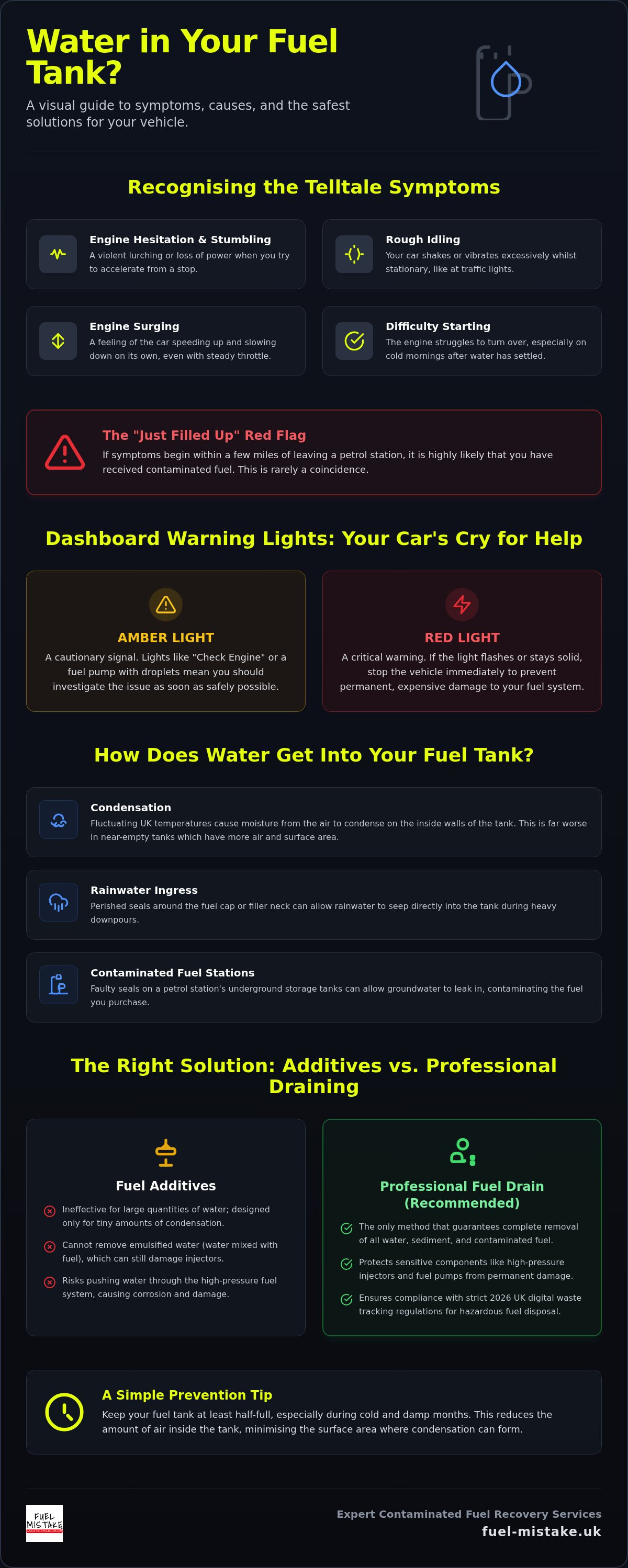
The most frequent water in fuel tank symptoms manifest as a violent hesitation or "stumbling" whilst you are trying to accelerate. You might feel the car lurch forward and then suddenly lose power as the injectors struggle to process the non-flammable liquid. Other common signs include:
- Rough idling: The car may shake or vibrate excessively when stopped at traffic lights.
- Surging: A feeling that the car is speeding up and slowing down on its own whilst you maintain a constant throttle.
- Difficulty starting: This is especially prevalent on cold mornings when settled water has had time to pool at the bottom of the tank.
- White exhaust smoke: This is actually steam being produced as the water passes through the combustion chamber.
The "Just Filled Up" Red Flag
If your engine begins to misbehave within a few miles of leaving a petrol station, it's rarely a coincidence. Identifying the difference between a mechanical failure and contaminated fuel is vital for avoiding unnecessary repair bills. Check your receipt immediately. Did you select the correct fuel grade? If you did, the contamination likely came from the station's own underground storage tanks, which can collect groundwater through faulty seals. If the symptoms started shortly after a top-up, don't assume your car has suddenly developed a complex mechanical fault; the fuel itself is the most likely culprit.
Dashboard Warning Lights to Watch For
Modern diesel vehicles are typically equipped with a Water in fuel sensor designed to alert you before the liquid reaches the delicate high-pressure injectors. This light usually looks like a fuel pump with droplets underneath it. You may also see the standard "Check Engine" or "Service Engine Soon" light appear because the engine's computer detects an irregular combustion pattern.
Pay close attention to the colour of these warnings. An amber light is a cautionary signal telling you to investigate the issue as soon as possible. However, if a red warning light begins to flash or stays solid, you must stop the vehicle immediately. Continuing to drive with a red fuel warning light risks permanent damage to your fuel pump and injectors, which are lubricated by the fuel itself and can be destroyed by the presence of water.
How Does Water Get into Your Fuel Tank?
Understanding the source of the problem is the first step toward a permanent fix. Whilst your vehicle's fuel system is designed to be sealed, environmental factors in the North East often bypass these defences. Fluctuating temperatures across North Yorkshire create a "breathing" effect in your tank; as the air cools, moisture from the damp British climate condenses on the internal walls. This liquid trickles down to the base of the tank, eventually triggering the water in fuel tank symptoms you are currently experiencing. Perished seals or a loose filler cap can also allow rainwater ingress during the heavy downpours common in Sunderland and Newcastle.
External sources are equally problematic. We frequently see contamination caused by misfuelling errors, such as incorrectly adding AdBlue or water-based cleaners directly into the diesel tank. A technical look at the Symptoms of Water in a Car's Gas Tank confirms that even a small volume of moisture can disrupt the combustion cycle and lead to immediate performance issues. Because water does not burn, it simply occupies space that should be filled with combustible fuel, leading to the "stuttering" effect you feel at the pedal.
The Danger of Low Fuel Levels
Driving on a near-empty tank provides more surface area for condensation to form. During a cold winter in Darlington or Durham, the large volume of air inside a mostly empty tank holds significant moisture. When this air cools, it deposits water directly into your fuel. Furthermore, the fuel pump is forced to draw from the very bottom of the reservoir, where water and sediment naturally pool. Keeping your tank at least half-full is a simple preventative measure that reduces the air-to-fuel ratio and limits moisture build-up.
Similar moisture challenges are a major concern for recreational boaters, leading many to switch to electric propulsion from Adventure Marine Ltd (electric-outboard.co.uk) to avoid the risks of fuel contamination and engine damage altogether.
These same principles of moisture control apply to home heating oil tanks; for residents in the Highlands, Moray, and Aberdeenshire, trustboilers.com is a reliable resource for maintaining efficient residential boiler systems.
Petrol Station Storage Issues
Not all contamination is the driver's fault. Ageing underground storage tanks at petrol stations can develop leaks, allowing groundwater to seep into the petrol or diesel supply. This is particularly common after flash flooding or sustained heavy rain. If you notice your car struggling shortly after a top-up, the station's own tank maintenance may be to blame. Always retain your receipt as proof of purchase. If you suspect you've picked up a contaminated batch, the team at Fuel Mistake® can provide a rapid on-site extraction to clear the system before the damage spreads to your injectors.
Fuel Additives vs. Professional Fuel Drains: Which is Safer?
When you first notice water in fuel tank symptoms, the temptation to reach for a £15 bottle of "water remover" at a local petrol station is high. It feels like a cost-effective solution to a potentially expensive problem. However, for owners of modern diesel vehicles, this "quick fix" is often a dangerous gamble that can lead to permanent engine damage. Additives generally work by using alcohol or enzymes to bind with water molecules, allowing them to pass through the combustion process. Whilst this might work for a lawnmower or an older, low-pressure engine, it is rarely sufficient for the sophisticated systems found in cars today.
Modern diesel engines, such as TDI, HDi, and CDTi models, are incredibly sensitive to moisture. These systems utilise high-pressure common rail technology where fuel is injected at massive pressures. Even microscopic droplets of water can cause cavitation, which is the rapid formation and collapse of vapour bubbles that can pit and erode metal surfaces. If you compare the price of a professional fuel drain to the cost of a new high-pressure fuel pump and a set of injectors, which can easily exceed £3,000, the "cheaper" additive suddenly looks like a significant financial risk.
The Myth of "Burning Off" the Water
There is a dangerous misconception that you can simply "burn off" water by driving the car at high speeds. This is physically impossible because water does not compress like fuel vapour. If a significant slug of water enters the combustion chamber, it can cause "hydrolock," where the piston attempts to compress the liquid and ends up snapping a connecting rod or cracking the engine block. Beyond immediate mechanical failure, moisture trapped in the system leads to internal rust and corrosion, which creates fine metal debris that will eventually clog your filters and ruin your injectors. Emulsification is the process of forcing water and fuel into a single, cloudy mixture that can strip away the critical lubrication needed by high-pressure diesel pumps, leading to metal-on-metal grinding and system-wide debris.
Why a Professional Drain is the Only Guarantee
A professional intervention is about more than just emptying the tank. To truly protect your engine, the entire fuel system must be addressed. At Fuel Mistake®, our technicians don't just drain the main reservoir; we flush the fuel lines and ensure the filter housing is free from residual moisture. We use specialist mobile equipment designed to extract every drop of contamination on-site. Once the extraction is complete, we verify that the fuel flow is clear and safe before we ever attempt to restart your engine. This methodical approach ensures that your high-pressure components are never exposed to the abrasive effects of contaminated fuel, giving you total peace of mind and protecting your vehicle's long-term health.
Immediate Steps: What to Do When Symptoms Appear
Engine coughing? Pull over now. If your vehicle begins to lose power or stumble whilst you are in motion, your priority is to find a safe place to stop immediately. Once you are off the main road, switch off the ignition. Do not be tempted to "limp" the car to the next service station or try to make it home to save on a call-out fee. Every second the engine runs, the fuel pump continues to draw from the bottom of the tank, forcing the settled water deeper into your delicate fuel lines. If you've already identified water in fuel tank symptoms, continuing to drive is the fastest way to turn a simple on-site drain into a multi-thousand-pound engine rebuild.
After the engine is safely off, check your dashboard for specific warning messages. Modern UK vehicles often display a "Water in Fuel" alert or a general "Drivability" warning. Note down exactly what you see. At this stage, you should call a specialised fuel drain professional rather than a general recovery truck. Most standard breakdown services will simply tow you to a garage where your car might sit for days waiting for a slot. A specialist mobile technician can perform the extraction right where you are, often getting you back on the road in under an hour without the need for a tow.
Protecting Your Engine from Further Damage
Why is it so critical to stay put? Your car's fuel filter acts as the first line of defence against moisture, but it has a very limited capacity to hold water. Once the filter is saturated, the water passes directly into the high-pressure pump and injectors. If your car is already sputtering, the filter is likely overwhelmed. When you call for help, explain your symptoms clearly to the technician. Mentioning whether the car stalled, if there was white smoke, or if the issues started immediately after a fill-up helps us prepare the right equipment for a faster diagnosis. For a broader look at handling various types of fuel contamination, you can consult our Misfuelling Guide.
Managing the Roadside Situation
If you find yourself stranded on a busy road in Newcastle or Middlesbrough, safety is paramount. Put on your hazard lights and, if it is safe to do so, wait behind the crash barrier or on the verge. Whilst you wait for assistance, gather your evidence. Find your most recent fuel receipt and take a photo of it alongside your dashboard mileage. If you suspect the contamination came from a specific petrol station, these records are vital for any future claim or dispute.
Don't risk further damage by trying to restart the engine to "see if it's cleared." It won't. Instead, contact Fuel Mistake® for immediate assistance. Our local technicians are equipped with specialist suction systems designed to purge your entire fuel system on-site, ensuring your engine remains protected from the corrosive effects of water contamination whilst getting you back on your way as quickly as possible.
Emergency Contaminated Fuel Removal in the North East
When you are faced with clear water in fuel tank symptoms, you don't have the luxury of waiting for a garage appointment next week. You need a solution that works right now, at the roadside or on your driveway. Fuel Mistake® provides a 24/7 rapid response service across Newcastle, Sunderland, and Durham, specifically designed to handle the high-stakes nature of fuel contamination. Our family-run business brings three generations of motor industry experience directly to your location, ensuring that a stressful situation is handled with professional calm and technical precision.
We utilise specialist mobile equipment that allows for complete contaminated fuel removal without the need for a recovery truck. Unlike standard mechanics who might suggest a new fuel tank or a lengthy stay in a workshop, our technicians focus on extracting the water and purging the system on-site. This approach not only saves you the cost of a tow but also prevents the long-term damage that occurs when moisture is left to sit in your fuel lines. We understand the local landscape and the urgency of your situation, which is why we prioritise getting you back on the road safely and quickly.
Our Coverage Areas in North Yorkshire and the North East
Speed is essential when dealing with water in fuel tank symptoms to prevent the onset of internal corrosion. Our fleet is strategically positioned to provide fast call-outs to Middlesbrough, Stockton-on-Tees, and Darlington. Because we are a local specialist, our technicians possess the regional knowledge required to navigate peak traffic across the Tyne Bridge or the A19, reaching you faster than national providers. We also extend our emergency services to more rural communities, including Thirsk, Northallerton, and Richmond. Whether you are stranded at a busy petrol station or stuck at home, our proximity ensures a rapid response time that minimises your downtime.
The Fuel Mistake® Professional Guarantee
Choosing a specialist means choosing a technician who understands the complexities of modern, high-pressure fuel systems. Every member of our team is fully certified and adheres to rigorous safety protocols. We take our environmental responsibilities seriously, especially with the introduction of mandatory digital waste tracking in April 2026. This system ensures that all hazardous waste, including your contaminated fuel, is recorded and disposed of at authorised centres in full compliance with UK law. You will receive a transparent service with no hidden garage fees, just honest, expert help from a dependable neighbour who takes pride in protecting your vehicle's engine.
Protect Your Engine and Restore Your Mobility
Identifying water in fuel tank symptoms early is the best way to avoid catastrophic engine failure. Whether you've noticed your car stumbling after a heavy North East downpour or it's hesitating following a trip to the pumps, acting immediately is vital. Remember that modern high-pressure injectors are incredibly sensitive to moisture. Whilst additives might seem like a quick fix, they cannot replace the safety of a full, professional system flush that removes every drop of emulsified water.
You don't need to face the stress of a non-starting car or the expense of a garage tow. Our family-run team brings over three generations of motor industry expertise directly to your roadside. We provide a 24/7 emergency response across Newcastle, Durham, and North Yorkshire, using specialist equipment to perform a complete on-site drain. This ensures your vehicle remains compliant with 2026 waste tracking standards whilst protecting your fuel pump from corrosion.
Stranded with contaminated fuel? Call Fuel Mistake® now for 24/7 emergency drain service. We'll handle the technical details and the hazardous waste disposal so you can focus on getting to your destination. You'll be back behind the wheel and driving with confidence in no time.
Frequently Asked Questions
Can I drive my car if there is water in the fuel tank?
No, you must not drive your car if you suspect contamination. Water lacks the necessary lubricating properties to protect modern fuel pumps and injectors. Driving with these water in fuel tank symptoms forces the liquid deeper into your engine, which can turn a simple drainage job into a multi-thousand-pound repair bill. Stop the vehicle immediately to prevent further damage.
Will water in the fuel tank clear itself if I add more petrol or diesel?
No, adding more petrol or diesel will not solve the problem. Water is denser than fuel and naturally settles at the bottom of the tank, precisely where the fuel pickup pipe is located. Filling the tank simply places fresh fuel on top of the water, meaning your engine will continue to draw the contaminated liquid first. The water must be physically extracted to ensure the system is safe.
How much does it cost to have water removed from a fuel tank in the UK?
The cost for professional fuel removal in the UK depends on several factors, such as the volume of contaminated fuel and whether the vehicle has been driven. Specialist mobile services are often more affordable than traditional garages because they avoid towing charges and long-term storage fees. It is best to contact a local technician for a quote tailored to your specific vehicle and location.
Can water in the fuel tank cause permanent engine damage?
Yes, ignoring water in fuel tank symptoms can lead to permanent and severe engine damage. Water can cause "hydrolock," where the engine attempts to compress the liquid and ends up snapping internal components like connecting rods. Additionally, moisture leads to internal rust and cavitation in high-pressure injectors, which often requires a complete and expensive system replacement if left untreated.
Does insurance cover water contamination from a petrol station?
Insurance coverage for fuel contamination varies significantly between providers and individual policies. Some comprehensive plans cover misfuelling or accidental contamination, but they rarely cover mechanical wear caused by long-term moisture build-up. You should always keep your fuel receipt and document any dashboard warnings to provide evidence if you decide to make a claim with your insurer or the petrol station.
How do I know if the sputtering is water or just a bad spark plug?
Timing and the severity of the engine's reaction are the best ways to tell the difference. If the sputtering started shortly after you visited a petrol station, the fuel is the most likely culprit. Water contamination usually causes violent surging and immediate stalling, whereas a bad spark plug typically results in a consistent, rhythmic misfire on a single cylinder that doesn't necessarily cause the engine to cut out.
What is the "Z" or "droplet" light on my dashboard?
This symbol is the "Water in Fuel" warning light. It often looks like a fuel pump with droplets underneath or a filter housing with water at the bottom. If this light illuminates, your car's sensor has detected moisture in the fuel system that has reached the filter. You must stop the vehicle and switch off the engine immediately to prevent the water from reaching the delicate high-pressure injectors.
How long does a professional fuel drain take to complete?
A professional fuel drain usually takes between 30 and 60 minutes to complete at the roadside. Specialist technicians use high-power suction equipment to extract the contaminated fuel and purge the lines. This mobile service is designed to be much faster than a traditional garage visit, as it eliminates the need for towing and avoids the long wait times associated with workshop scheduling.


