
Did you know that nearly 30% of UK motorists have accidentally put the wrong fuel in their car? If you are currently standing at the pump with a sinking feeling in your stomach, you are not alone. You are likely worried about a multi-thousand pound repair bill or whether your engine is permanently ruined. It is a high-stakes, stressful moment, especially if you are a business owner—such as a caterer who relies on Hopkins catering equipment—and cannot afford any vehicle downtime. However, a professional wrong fuel recovery is designed to solve this exact crisis without the need for a costly tow or a week in the garage.
We understand that you need clear instructions and technical reassurance right now. This guide reveals the safest, fastest, and most cost-effective way to recover your vehicle whilst avoiding expensive engine damage. We will walk you through the essential "do not start" protocols, the mechanical reality of fuel contamination, and how a mobile specialist can get you back on the road in under 90 minutes. You don't have to face a main dealer's extortionate fees; instead, learn how an on-site fix provides the professional documentation and engine safety confirmation you need for total peace of mind.
Key Takeaways
- Understand why professional wrong fuel recovery is a precision mechanical procedure that prevents permanent damage to high-pressure fuel pumps and injectors.
- Save time and money by choosing a mobile fuel drain over main dealership services that often involve long backlogs and significantly higher costs.
- Identify the chemical risks of misfuelling, such as how petrol acts as a solvent to strip vital lubrication from your diesel engine.
- Learn what to expect during a roadside recovery, from the initial vehicle diagnostic check to the specialised vacuum extraction process.
- Discover the benefits of using a local, family-run specialist in the North East for faster response times and 24/7 technical expertise.
What is Wrong Fuel Recovery and Why Does it Matter?
Professional wrong fuel recovery is far more than a simple roadside assist. It is a technical, on-site mechanical procedure designed to save your engine from catastrophic failure. When you put the wrong liquid in your tank, a chemical reaction begins that can compromise your vehicle's entire fuel system within seconds. This process involves the precision extraction of contaminated fuel, a comprehensive system flush, and a diagnostic check to ensure no metal filings or debris have reached the injectors.
The risks are immediate and severe. In a diesel vehicle, petrol acts as a solvent. It strips away the vital lubrication required by the high-pressure fuel pump and common rail system. Without this lubrication, metal components rub together, creating fine shards that can ruin an engine. Conversely, understanding how petrol engines work clarifies why diesel is so problematic for them; it doesn't atomise correctly, leading to fouled spark plugs and heavy smoke. By 2026, safety standards for this work have become even more rigorous. Technicians must now use ATEX-certified pumps to prevent explosions and follow strict environmental disposal protocols for the hazardous waste they recover.
The 'Golden Rule' of Misfuelling
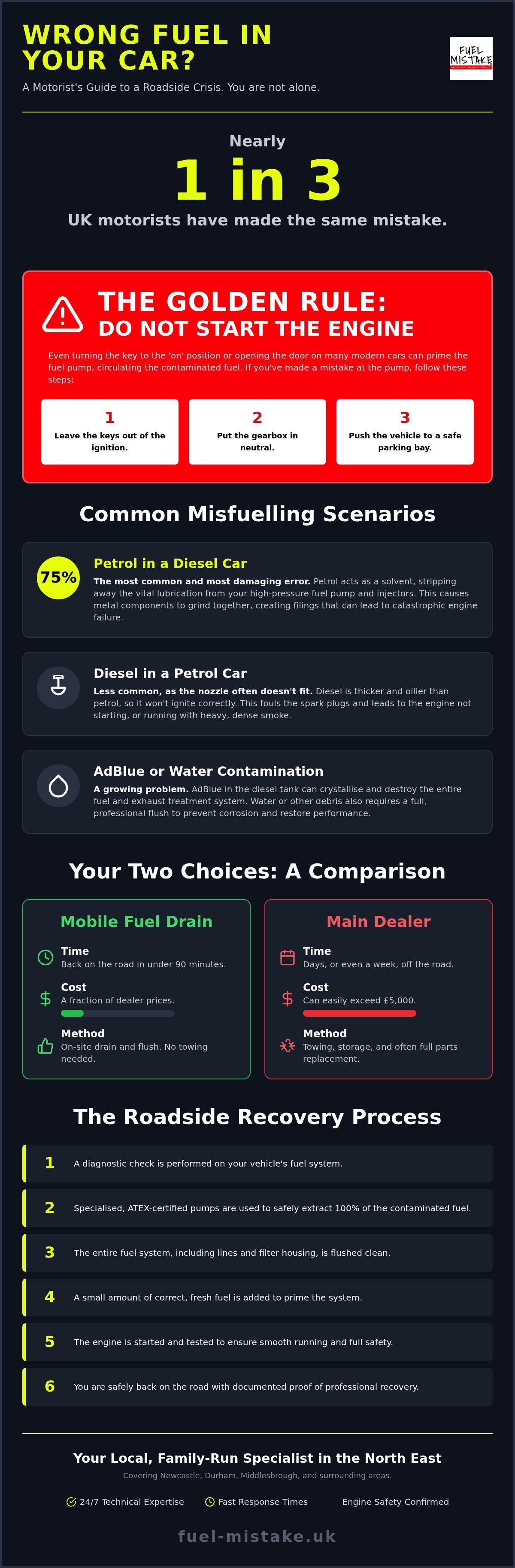
Stop. If you realise your mistake at the pump, do not turn the ignition. Many modern vehicles start the fuel pump the moment you turn the key to the 'on' position or even when you open the driver's door. This circulates the contamination through the lines before the engine even fires. If you are currently at a petrol station in Newcastle, Durham, or Middlesbrough, leave the car exactly where it is. Put the gearbox in neutral and ask for help to push it to a safe parking bay.
Common Scenarios for Wrong Fuel Recovery
Petrol in a diesel car remains the most frequent error, accounting for roughly 75% of all callouts. It is also the most damaging due to the lubrication loss mentioned earlier. Diesel in a petrol car is less common because petrol nozzles are usually too wide for diesel tanks, but it still happens. This mistake typically results in a car that won't start or runs with heavy smoke. Finally, we frequently see contaminated fuel issues where water or debris has entered the tank, requiring a full professional flush to restore performance. Many of these incidents occur during the stress of a relocation; if you are planning such a move, using a specialised service like Fool Movers for small-scale transport across Europe can help reduce the logistical burden.
Mobile Fuel Drain vs. Main Dealer: Comparing Your Options
When you realise you have misfuelled, you face a critical choice: call a mobile specialist or have your vehicle towed to a main dealer. This decision often dictates whether you are back on the road in an hour or facing a week of mechanical delays. A main dealer approach typically involves the 'towing trap.' This means paying for a recovery truck to move your car to a service centre, followed by daily storage fees while you wait for an available workshop slot. In contrast, a professional wrong fuel recovery is performed wherever your car is currently parked, eliminating recovery costs entirely.
The financial difference is often staggering. Main dealers usually follow rigid manufacturer protocols that mandate the replacement of the entire fuel system, including the high-pressure pump and injectors. These bills can easily exceed £5,000. A mobile specialist understands the chemical differences between petrol and diesel and uses this knowledge to safely flush the system rather than replacing expensive parts. By using high-suction vacuum units, they can remove every trace of the incorrect fuel before it causes permanent damage. If you are stranded now, our mobile fuel drain service provides a rapid response that avoids these unnecessary overheads.
The Garage Approach: Why it Costs More
Main dealer service centres in Newcastle and Durham operate with high labour rates and significant administrative overheads. They rarely possess the specialised, portable equipment required for a rapid fuel drain. Instead, they must manually dismantle the fuel tank or use workshop lifts, which adds hours to the invoice. Their primary goal is often warranty protection through total component replacement, even when a thorough flush would suffice. This 'scorched earth' policy is why garage-based wrong fuel recovery is the most expensive route for any motorist.
If you are managing a business and want to avoid high overheads elsewhere, you can discover Green Compare to find competitive rates on commercial utilities and finance solutions.
The Mobile Specialist Advantage
A mobile technician is a dedicated specialist. Their vehicle is a mobile workshop equipped with ATEX-certified pumps and custom-built fuel storage tanks. This allows them to perform a complete drain and system flush at the roadside, your home, or your workplace in roughly 40 minutes. You get direct access to the technician, who can provide immediate mechanical reassurance and a diagnostic report for your records. This on-site expertise ensures your engine is safe without the stress of leaving your car in a distant garage for several days, a standard of convenience also seen with mobile specialists like Tyres at your door who provide tyre repairs directly to your location.
The Mechanics of Misfuelling: Petrol, Diesel, and AdBlue
Misfuelling triggers a destructive chain reaction within your vehicle's engine that goes far beyond a simple lack of power. When you put petrol into a diesel engine, you are introducing a powerful solvent into a system designed for oily, lubricating diesel. Diesel fuel is a lubricant that protects the high-pressure fuel pump and common rail injectors. Petrol lacks these lubricating properties and actively strips away the thin film of oil protecting these precision-engineered parts. Without this barrier, metal-on-metal contact occurs, generating microscopic metal shards that can travel through the entire system, necessitating a comprehensive wrong fuel recovery to prevent total engine seizure.
Diesel in a petrol car presents a different set of mechanical challenges. Because diesel is heavier and less volatile than petrol, it does not atomise or burn correctly within the combustion chamber. This leads to heavy exhaust smoke and rapid spark plug fouling, as the unburnt fuel leaves a thick, oily residue. While this is often perceived as less damaging than petrol-in-diesel, the resulting carbon buildup can still cause significant performance issues if not addressed by a professional flush.
By 2026, the environmental standards for handling these mixtures have tightened significantly. Every litre of contaminated fuel we extract is no longer simply disposed of; it is transported in sealed, ATEX-certified containers to specialised recycling centres. Here, the mixture is processed to separate the hydrocarbons, allowing the fuel to be repurposed for industrial heating or other secondary uses, minimising the ecological footprint of your mistake.
Managing the environmental impact of transport is a complex task; while we handle fuel recovery, firms like ML Traffic Engineers UK manage the broader challenges of transport planning and traffic engineering documentation for new developments.
AdBlue in Diesel: The Silent Engine Killer
Many motorists don't realise that AdBlue is a urea-based solution, not a fuel. If you accidentally pour it into your diesel tank, it won't just cause poor running; it will cause rapid crystalline buildup. As soon as AdBlue meets diesel, it begins to crystallise, clogging fuel lines and sensors with white, salt-like deposits. It is also highly corrosive to the aluminium and steel components found in modern fuel tanks. For a detailed breakdown of the chemical risks, read our AdBlue in diesel tank guide.
Symptoms of Misfuelling Whilst Driving
If you have already left the forecourt, your car will soon give you clear warning signs. You might experience a sudden loss of power, known as 'limp mode,' accompanied by loud knocking sounds or excessive smoke from the exhaust. If your vehicle begins to judder or cuts out entirely whilst driving on the A1 or A19, pull over to a safe location immediately. Do not attempt to restart the car, as this only forces more contamination into the engine. You can find a full list of red flags in our misfuelling symptoms guide, which explains what to look for before calling for wrong fuel recovery.
The Wrong Fuel Recovery Process: What to Expect Roadside
When a specialist arrives to perform a wrong fuel recovery, the process is methodical and clinical. It begins with a dynamic risk assessment to ensure the vehicle is in a safe position for fuel extraction. The technician then performs a diagnostic check to determine how far the contaminated fuel has travelled. If the engine hasn't been turned over, the job is usually a straightforward tank drain. However, if the ignition was engaged, the process expands to include the entire fuel delivery system to prevent lasting damage.
The core of the recovery involves high-powered, vehicle-mounted vacuum units. These are far more efficient than simple siphoning kits used by general breakdown clubs. We don't just remove the bulk of the fuel; we strip the system back to a clean state. This includes clearing the fuel lines, the high-pressure fuel rail, and the injectors themselves. Once the contaminants are removed, we replenish the tank with enough fresh fuel to thoroughly flush the system and prime the pump. If you need immediate assistance with this technical procedure, our mobile fuel drain experts are available across the North East 24/7.
Step-by-Step: The Professional Drain
- Accessing the Tank: Depending on your vehicle's make and model, we access the fuel via the specialised sender unit under the rear seat or directly through the fuel lines in the engine bay.
- ATEX-Certified Extraction: We use specialised equipment designed for explosive atmospheres. This prevents static build-up and sparks, ensuring the safety of everyone on the forecourt.
- 99.9% Contaminant Removal: Our vacuum technology ensures that virtually every drop of the incorrect fuel is extracted, leaving no residue to interfere with the fresh petrol or diesel.
Post-Drain Testing and Peace of Mind
After the drain is complete, the technician will prime the fuel system to remove any air pockets. We then start the engine and monitor the idle for smoothness and consistency. For modern vehicles, this stage also involves using diagnostic software to clear any 'low fuel pressure' or 'misfire' fault codes stored in the ECU. You will receive a digital receipt and a formal waste transfer note, confirming that the hazardous fuel has been handled according to UK environmental regulations. This documentation is vital for maintaining your vehicle's service history and providing proof of professional intervention for insurance purposes.
Choosing a Specialist for Wrong Fuel Recovery in the North East
When you are stranded at a petrol station or by the side of a busy A-road, proximity is everything. Choosing a local specialist for wrong fuel recovery ensures a faster response time than waiting for a national breakdown club to dispatch a distant patrol. In the North East, local knowledge of the road network from Newcastle down to North Yorkshire allows for a rapid, 24/7 arrival. This speed is vital for prioritising your safety and minimising the time contaminated fuel sits in your system. This reliance on local experts is a principle that applies to all essential services across the UK, whether you need emergency fuel assistance in the North East, a reliable Carpet Cleaner In Manchester for your property in the North West, or professional heating support from Plumbing & Boilers London in the capital.
Technical credentials are just as important as speed. You should always verify that your technician holds a Safety Passport Alliance (SPA) accreditation and carries a current environmental license for hazardous waste disposal. As a family-run business with three generations of motor industry experience, Fuel Mistake® combines this formal certification with a deep-rooted professional heritage. Our founder's background as a prestige dealership technician means even high-end performance vehicles receive the specialised care they require. We don't just drain the tank; we protect your vehicle's mechanical integrity. While we focus on recovery in the North East, for those based in the North West looking to further optimise their engine's performance, you can learn more about the specialist services provided by Dynogen Remapping Solutions.
Our Local Coverage Areas
We provide comprehensive mobile support across the entire region. If you have made a mistake at the pumps in Teesside, we offer a rapid response for wrong fuel in Middlesbrough. For those further north, we provide specialist help for petrol in diesel in Newcastle. Our fully equipped mobile units also cover Durham, Sunderland, and Stockton-on-Tees, ensuring that professional help is never far away regardless of your location. We know these roads. We know how to get to you quickly, even during peak traffic hours.
The Fuel Mistake® Guarantee
Our service is built on transparency and technical excellence. Unlike main dealers, we don't charge hidden storage or towing fees; you pay only for the precision extraction and system flush. You can trust that your vehicle is in the hands of a specialist who understands the intricate mechanics of modern fuel systems. We pride ourselves on being the dependable neighbour who arrives with the right tools and the right training. If you are currently stuck, contact Fuel Mistake® for immediate wrong fuel recovery and let our family-run team get you back on the road safely.
Secure Your Engine with Professional Recovery
Misfuelling is a high-stakes mistake, but it doesn't have to result in a multi-thousand pound repair bill. The choice between a rapid roadside fix and a costly week at a main dealer often comes down to acting quickly and keeping the ignition off whilst you wait for help. Professional extraction ensures that every trace of contamination is removed using ATEX-certified equipment, protecting your high-pressure fuel pump and injectors from permanent damage. This standard of professional roadside care is universal; for instance, motorists in the North West can rely on H Roadside Rescue for 24/7 recovery and mobile tyre services.
You deserve the peace of mind that comes from technical expertise and local reliability. With three generations of motor industry experience and SPA Passport certified technicians, our family-run team is ready to assist you. We provide a 24/7 mobile service across the North East, from Newcastle to Middlesbrough, ensuring you're never stranded for long. Don't let a simple error ruin your day or your vehicle's mechanical integrity. Call Fuel Mistake® for 24/7 Emergency Wrong Fuel Recovery and let us get you back on the road safely. You've got this, and we're here to help.
Frequently Asked Questions
Will putting the wrong fuel in my car ruin the engine permanently?
Misfuelling rarely causes permanent engine ruin if you stop the vehicle immediately. The primary risk is the lack of lubrication in diesel systems or misfiring in petrol engines. A professional wrong fuel recovery removes these contaminants before they cause catastrophic wear. If you have already driven the car, the risk to the fuel pump increases, but a thorough system flush usually restores full mechanical functionality without needing a replacement engine.
How much does wrong fuel recovery cost in the UK in 2026?
The cost of a fuel drain depends on the volume of fuel involved and whether the engine was started. A standard roadside extraction is the most cost-effective route for any motorist. However, if the contamination has reached the injectors, the price increases to cover the extensive flushing required. AdBlue removal is typically more expensive than a standard petrol or diesel swap because of the specialised equipment needed to clear crystalline buildup.
Can I use my breakdown cover for a fuel drain service?
Most standard breakdown policies do not include misfuelling as a core benefit. Research indicates that a majority of UK comprehensive policies exclude damage caused by the wrong fuel. While some national clubs offer the service as an add-on, they often have long wait times. Calling a local specialist is frequently faster and more reliable than waiting for a general patrol that may lack the specific high-suction vacuum equipment required. This same principle of relying on local experts applies to all roadside needs, such as the professional support provided by Instant Recovery for those in the London area.
What happens if I started the engine after putting petrol in my diesel car?
Starting the engine circulates petrol through the high-pressure pump and injectors, stripping away the oily film that protects these parts. You may notice knocking sounds, smoke, or a sudden loss of power. Switch off the engine immediately. A technician will need to flush the entire fuel delivery system, not just the tank, to ensure no petrol remains to cause metal-on-metal friction damage within your engine's precision components.
Is it possible to drain the fuel tank myself at the petrol station?
You should never attempt to drain a fuel tank yourself. Modern vehicles are fitted with anti-siphon flaps that make manual siphoning nearly impossible. Furthermore, handling flammable liquids in a public space without ATEX-certified equipment is a significant fire risk. UK environmental laws also mandate that contaminated fuel must be transported and disposed of at licensed facilities, making professional wrong fuel recovery the only legal and safe option available.
How long does a mobile fuel drain take to complete?
A standard mobile fuel drain usually takes between 30 and 40 minutes once the technician is on-site. This timeframe includes the initial safety assessment, the full vacuum extraction of the contaminated fuel, and the priming of the system with fresh fuel. Most drivers are back on the road within 90 minutes of their initial call, which is significantly faster than waiting for a tow truck and a garage workshop slot; this model of mobile convenience is also employed by specialists like partnertires.com who provide on-site tyre support.
Will misfuelling affect my car's manufacturer warranty?
Misfuelling can potentially void parts of your warranty if the fuel system is damaged and not professionally repaired. Main dealers often recommend replacing every component at a cost of thousands of pounds to protect the warranty. However, using a specialist who provides a formal technical report and waste transfer note proves that the contamination was removed to industry standards. This documentation is vital for maintaining your vehicle's service history and mechanical integrity.
Do you provide a receipt for insurance claims after a fuel drain?
Yes, we provide a full digital receipt and an official waste transfer note upon completion of the job. These documents are essential if you intend to claim the cost back through your insurance provider or if you need to prove professional intervention for your service records. It provides clear confirmation that the engine is safe and that all hazardous materials were handled according to UK environmental and safety regulations.


